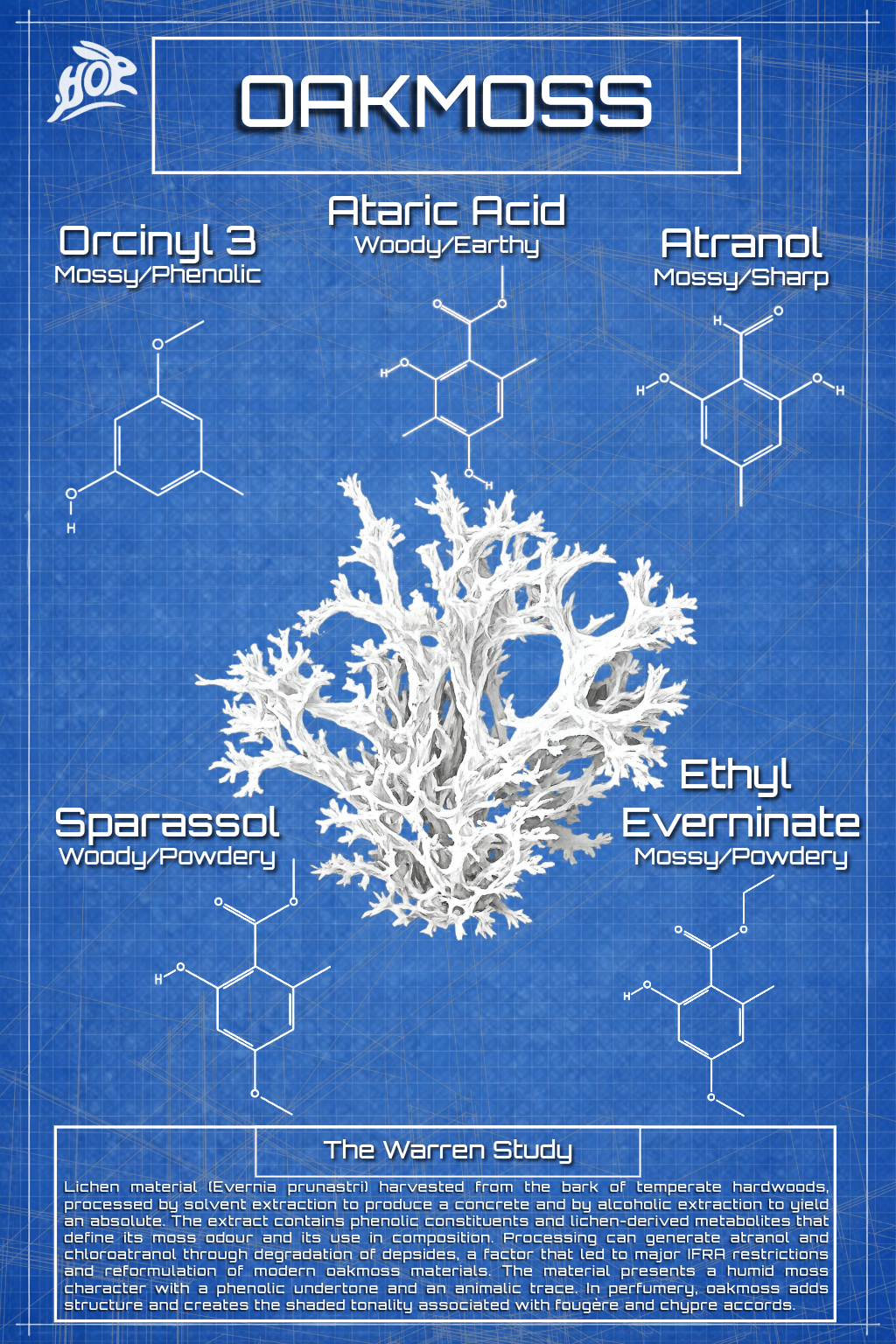
Oakmoss (Evernia prunastri (L.) Ach)
Algae’s survival depends on constant contact with water, which is why it lives in our waterways — except in cases where it enters into symbiosis with another species. Like Venom and Eddie Brock, algae teams up with fungi to form the lichen Mousse de chêne, often confused with a moss, which we call Oakmoss.
Egyptians used it 5000 years ago as an embalmer in mummy preservation, where the bodies would remain perfumed for centuries. In the eastern Mediterranean, it was used as a panacea and became one of the first ingredients in fragrant soap making, along with Lavender and Geranium.
Coty made it a staple in fine fragrance when, in 1917, inspired by the island of Cyprus, he combined it with Patchouli to create Chypre de Coty. In 1919, Guerlain then used it alongside Vetiver, benzoin, coumarin, and ionones to create his own chypre, Mitsouko. Chypre’s are incomplete without it.
In modern perfumery, benzene is used to extract the Oakmoss, which evaporates and is then filtered, creating a creamy green concrete. It’s then washed with ethanol, and the chlorophyll is further removed through molecular distillation.
100kg of Oakmoss will provide 1kg of this finished absolute.
In the world of perfumery, atranol and chloroatranol are two of the most powerful skin allergens; both are found in unadulterated Oakmoss absolute, due to degradation during processing. These molecules also give top-note bite to classic Oakmoss, unlike Ataric Acid, which aids in fixation and adds the powdery-sweet woody note.
Over 80 molecules make up the profile of Oakmoss extracts. Here are your main players.