Orris Root (Iris)
For centuries, irises have been sacred symbols of royalty and protection, as in Japan, where since the Nara period, the roots and rhizomes have been hung from roof awnings to ward off evil spirits. In Rome, wealthy Romans used ground-up root powder on their face and in their hair as a perfumed deodorant; apothecaries stocked aged rhizomes as a medicine, steeped in tea, to treat ailments like coughs and lung congestion. Van Gogh painted Irises during his self-admitted stay at the Saint-Paul-de Mausole asylum in May of 1869, where he immediately began painting the “soft and harmonious flowers” that covered the countryside estate there in the south of France, where irises still dance in the spring fields to this day.
It was even used to cover up the smell of arsenic to carry out political assassinations during the Renaissance.
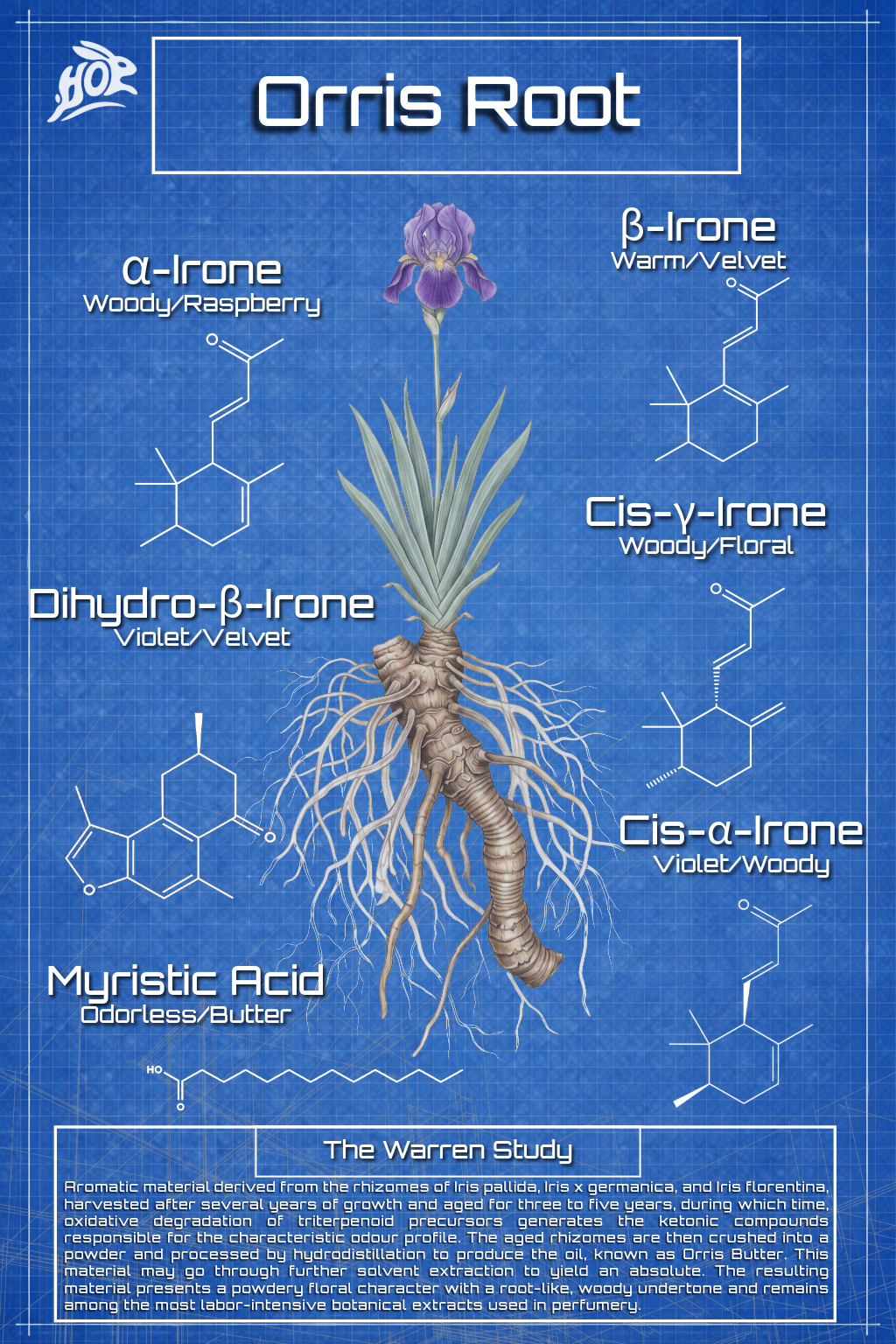
While the flowers are pretty, they don’t carry a noticeable scent. The prize is in the rhizomes, which are part of some plants’ underground food storage and reproductive systems; they grow horizontally beneath the ground, where they send off new roots and shoots as they spread, which can be divided at their nodes to produce an independent plant. The harvested roots are aged for a minimum of 3 years before being turned into a powder, then steam distilled, producing a solid paste called “orris butter” for its smooth, buttery floral scent, derived from the irone molecules unique to orris root and reminiscent of Violets’ ionones.
Irones make up most of the scent profile of orris root, as you’ll see on the blueprint, with each molecule playing its own role in the overall scent profile.
The species of Iris and the extraction method make all the difference in the world when it comes to irone content in a finished orris product. Sweet Dalmatian iris, iris pallida Lam., is the most prized, while iris germanica and iris florentina are also used. Orris butter itself has a meager 20% irone content. To get more, the material needs to undergo further solvent extraction and be turned into an absolute, one of the most expensive materials in perfumery, where irones can reach 80%.