

Agarwood/Oud
The Ranjatai was a gift given to Emperor Shōmu of Japan by the Tang Court of China in the 8th century. This legendary piece of Agarwood is rumored to have the "perfect scent," and it still survives today at the Shōsōin treasure house, where it is sometimes removed, small pieces shaved off, and burned as incense.
Agarwood, also known as Oud, or Aloeswood, Eaglewood, and Jinkoh, is as mysterious as it is rare and expensive. It smells of rich wood, fruit, flowers, and a slight animalic note, like nothing else. Which is why it's been so prized for centuries. To the point that the tree is now critically endangered.
Heavily regulated now by the governments from which it comes, wild Agarwood is rare. Most is farmed via plantation, where quality oud is tested by placing it in water. The best quality oud will sink. Lower grades will float at the top. The best is sent off to the incense trade, while the lower quality chips and chunks are distilled for essential oil.
In perfumery, Oud has taken center stage, and marketing has run its course. From bad oud accords to hyperbolic marketing copy making exaggerated claims. The reality, Oud is a base note that has a good impact, but low strength. Warms, rounds, and adds character to blends, but rarely stands out on its own, and isn't used at high enough percentages of formulas to really do so.
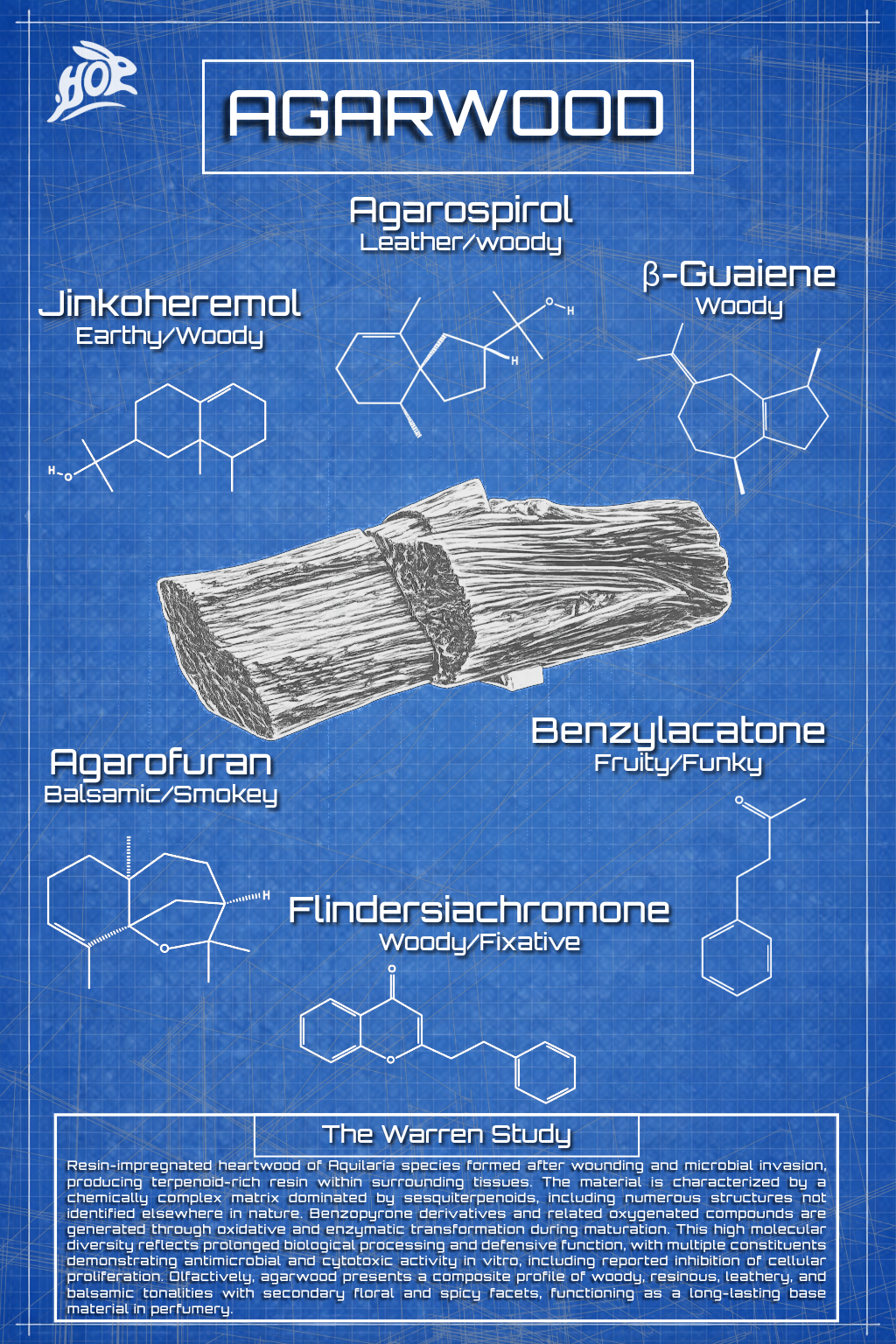
Want to get into chemistry? Take a look at the Blueprint for what makes up the scent. Keep in mind, there are dozens of terpenes Agarwood produces that aren't found anywhere else in nature. These are only the top fragrant constituents.