Ambergris
Sperm whales dive down to the ocean floor and feed on bottom-dwellers: rockfish and rays, cod, sharks, and deep-water squid. They’ll then swim back to the surface for a breath of fresh air and a bathroom break. Easy living. Except maybe for the fact that their favorite meals are those giant deep-water squid that happen to wreak havoc on the whale’s insides with their quills and beaks. Like a dog that ate too fast, they’ll regurgitate much of it back out. There’s nothing of value here. When you’re eating a literal TON of squid a day, however, some remain in the stomach and make it into the whale’s intestines.
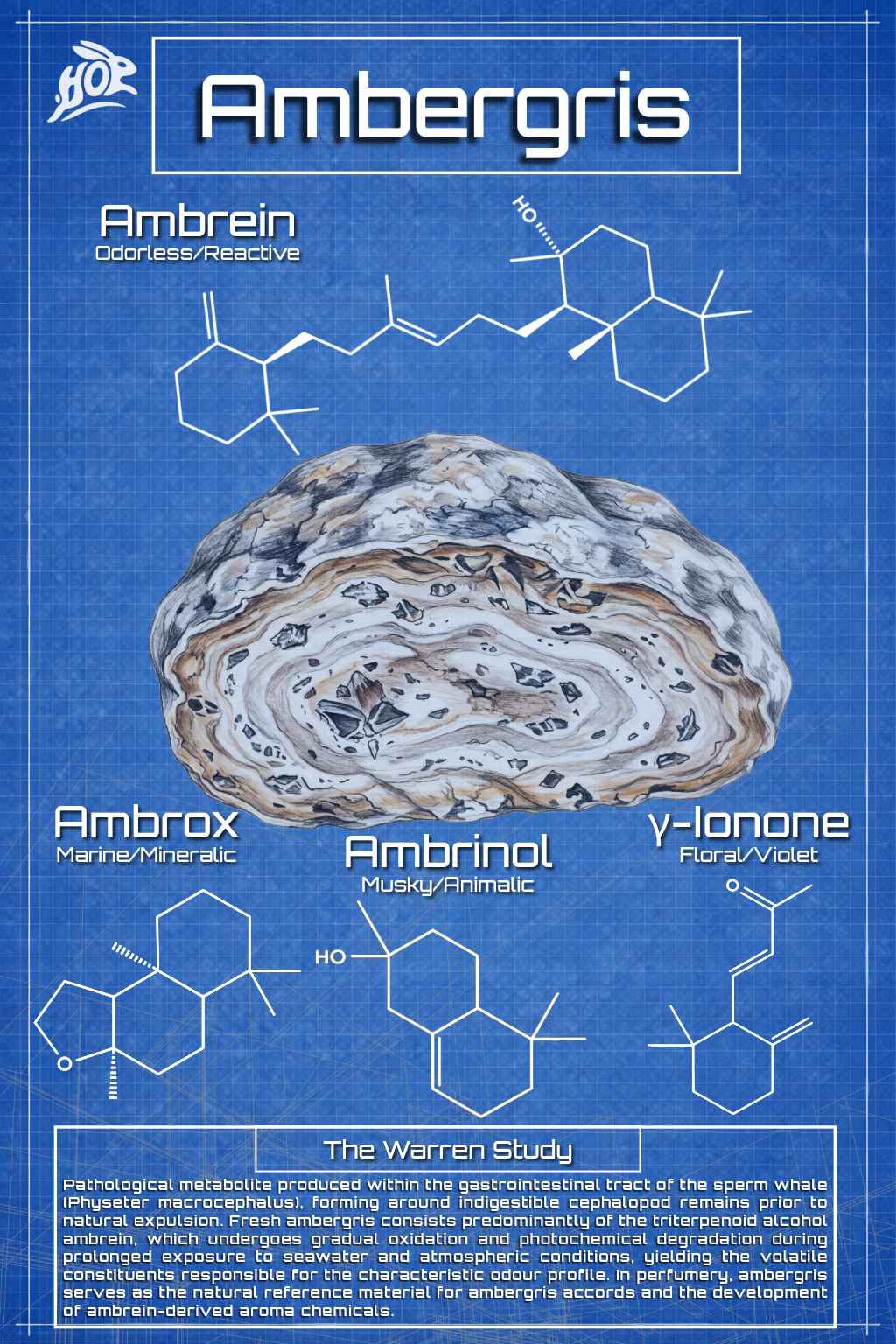
Here in the intestines of the sperm whale (and also found in elephants, giraffes, buffalo, cattle, and even humans) is an odorless triterpene alcohol called Ambrein. In the whale’s intestines, ambein collects with the beaks, shells, and waxy waste matter, including the copper-rich protein called ‘hemocyanin’. Smaller globs can be defecated, while larger masses build up until the whale dies — not necessarily from the mass itself. When these concretions are released into the water, the copper triggers photo-oxidation in the ambrein, and a slow alchemy begins.
Time is everything now. Over time, the dark waxy mass hardens and turns pale in the sunny salt-soaking sea. Over time, ambrien oxidizes into ambroxide and ambrinol, the molecules that make up the majority of Ambergris’ scent. The more time, the more molecular conversion takes place.
Firmenich originally isolated Ambroxide in a semi-synthetic process from sclareol, a terpenic alcohol found in Clary Sage, back in 1950 (patented), before we knew its importance in the composition of Ambergris, which was confirmed in 1977. Today, many forms of Ambroxide are on the market under different trade names, both synthetic and naturally derived.
Ambergris is extracted for use in perfumery through tincturing: a slow coaxing of a material’s matter into ethanol. More time. At least 3 years for a ready-to-use product, though 10-20 years of maceration yields an ideal concentration.
Here’s the blueprint for Ambergris.