Lavandula Angustifolia- True Lavender
Elzéard Bouffier had been widowed in the early days of the 1900s and settled as a shepherd on the foothills of the Alps de Haute Province, where nothing but fields of true Lavender grew. He would spend his days herding his sheep across the uplands, where he would poke holes in the ground with his staff and plant acorns along the way.
By the time the first Great War was coming to an end, the acorns had become saplings, and the French Government took their growth as a sign of divinity (unbeknownst to them of Elzéard’s acorn planting), giving the new growth forest national protection, and by the middle of the century, thousands of people had settled the area to make a life for themselves.
This is the story Jean Giono told in The Man Who Planted Trees. While the story is considered fiction, many believe it is the true story of Jean’s own experience after the war, and that Elzéard was a real person. And while the story’s overall truth comes into question, one thing that cannot is this hilly region at the base of the French Alps, where some of the finest lavender in the world grows.
Lavender has many different species, and a handful are used in perfumery, where their common names can become a bit convoluted. Even within the same species, the scent profiles of Lavender are dramatically impacted by its terroir. The higher the elevation, the cleaner and sweeter the scent. Lower elevations give rise to camphorous and herbal notes.
Hence, this region in Haute-Provence, at the base of the French Alps, is an important growing environment for lavender. This is where you’ll find the true lavender, Lavandula Angustifolia, though further into the valleys, as you move towards Grasse, you’ll find swaths of lavender fields in a paler blue. This is Lavandula Latifolia, or spike lavender, along with Lavandula Intermedia, known as Lavandin. Lower in floral linalool and higher in camphor and terpenes, these lavenders are cheaper and pass for the original to unsuspecting eyes and noses.
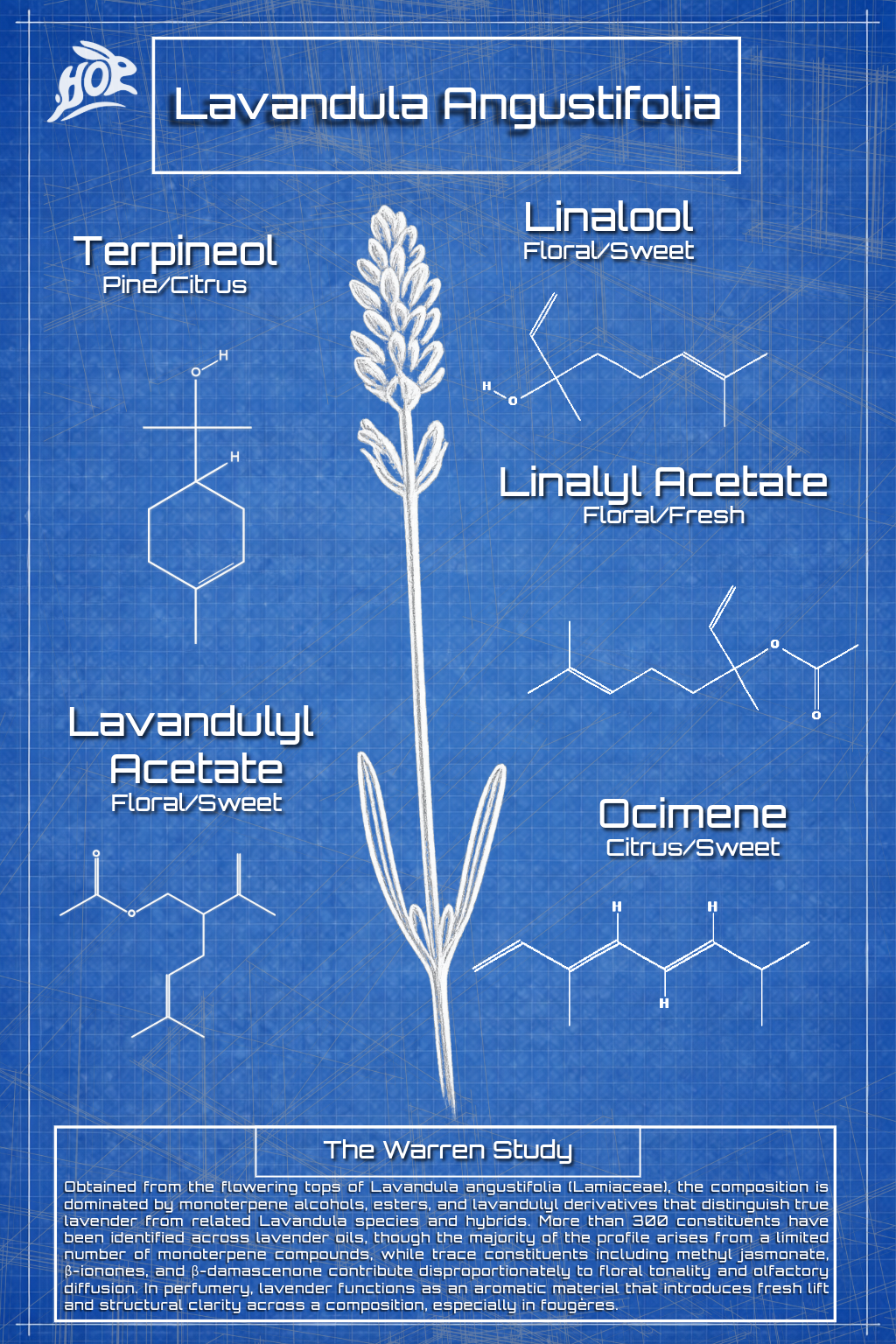
When grown in the right conditions, Lavender smells of white linen on the line, basking in the warm August sunlight over a field of wildflowers, where it is almost completely made up of Linalool and Linalyl Acetate. Its character is defined in low levels by Lavandulyl acetate.
Here is the full Blueprint for Lavandula Angustifolia.